


Explainer: Why Fannie Nkosi was arrested and what happened in court
Kgomotso Modise
8 April 2026 | 4:55The first arrest linked to the Madlanga Commission investigations has landed in court, as Sergeant Fannie Nkosi faces charges unrelated to his testimony but tied to evidence seized during a raid at his home.
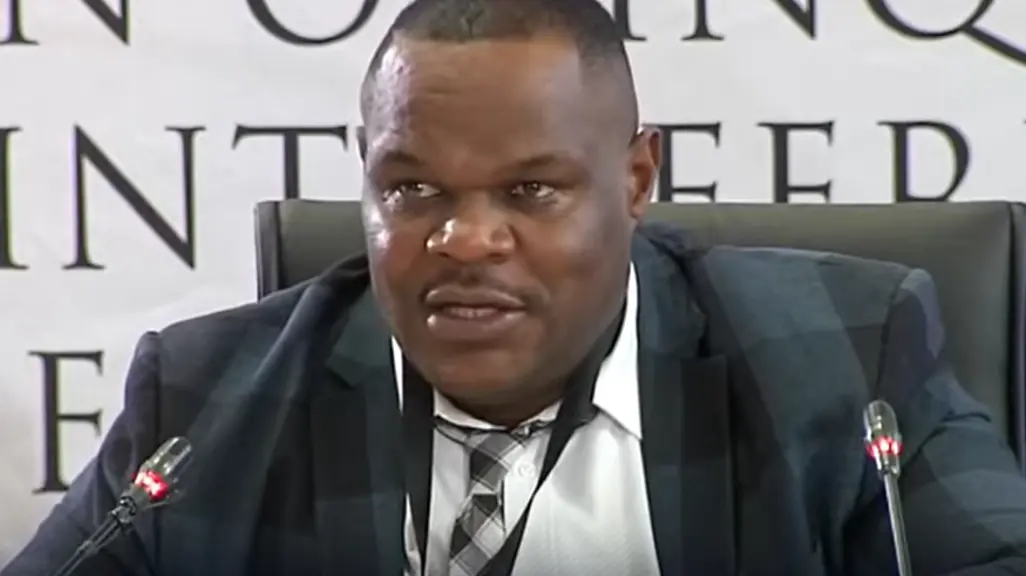
Sergeant Fannie Nkosi of the Guateng's Organised Crime Unit giving testimony at the Madlanga Commission of Inquiry on 23 March 2026. Picture: Screenshot
Suspended police officer Fannie Nkosi appeared in the Pretoria North Magistrate’s Court on Tuesday, five days after his arrest at his home in Dorandia, Pretoria North. His arrest followed a search-and-seizure operation carried out by the newly appointed Madlanga cases task team.
In January, President Cyril Ramaphosa announced the establishment of a special task team to investigate cases emanating from the commission of inquiry. Nkosi’s case is one of the first in which an arrest has been made.
The disgraced sergeant spent eight days on the witness stand at the commission, responding to allegations about his links to alleged crime bosses Vusimuzi ‘Cat’ Matlala and Katiso ‘KT’ Molefe.
ALSO READ:
Nkosi asks not to be taken to Kgosi Mampuru Prison, saying he fears for his life
Suspended officer was found with cache of weapons and stolen case dockets
Search and seizure warrant executed at home of Sergeant Fannie Nkosi
Nkosi is accused of acting as a middleman between these figures and senior police officers, including suspended senior officer General Shadrack Sibiya.
However, while Nkosi’s arrest was effected by the Madlanga task team, the charges against him are not directly linked to the criminal allegations raised at the commission. Instead, they relate to what was discovered during the raid at his home.
According to police, after Nkosi was officially suspended on 28 March, he was required to hand over all SAPS property, including his service pistol, ammunition and dockets. Investigators allegedly received a tip-off about “suspicious activity” at Nkosi’s Dorandia home, prompting them to apply for a search warrant.
Police spokesperson Athlenda Mathe said the warrant was granted on 2 April and immediately executed.
Mathe said Nkosi was found in possession of seven licensed firearms, state-issued ammunition and six dockets.
Firearms and ammunition
Mathe said only four of the seven firearms were found in a safe, as required by the Firearms Control Act.
“The safe where the four firearms were found was not mounted on a wall or the floor. They then found three other firearms. A .38 special revolver was found between the mattresses in his room, which is another contravention, because all firearms must be stored in a safe. They also found a Norinco R5 under his bed, which is another contravention. A 9mm Beretta pistol was found in his car,” she said.
Nkosi was also found with multiple rounds of ammunition, including 35 AK-47 rounds and 9mm R5 rounds. Police also recovered state-issued ammunition that Nkosi was required to hand over upon his suspension.
Dockets
During the search of Nkosi’s Wendy house, police found six dockets, five originals and one copy. This contradicts claims made in court by Nkosi’s lawyer, Advocate Sazi Dlali, who said all the dockets were copies.
Mathe noted that all the dockets are linked to serious and violent crimes.
“These include CIT robberies, one in Roodepoort, one in Musina, Limpopo, as well as two car hijacking cases. Upon further investigation, we found that the cases were closed as undetected. This means there were no leads or new information, and the cases were archived,” she said.
Police explained that dockets of archived cases should not be in the possession of an investigating officer, but should instead be stored in SAPS facilities.
Court proceedings
When the matter appeared before Magistrate Rene Venter, she addressed an application by the media to record and broadcast proceedings. While the State did not oppose the application, Nkosi’s legal team said they needed time to consider it and raised concerns about the timing of the request.
In most cases, courts allow media applications for recording or broadcasting to be made on the day of the appearance. However, Venter insisted that the application should have been submitted the day before.
This was despite the State explaining that Nkosi was arrested just before the Easter weekend and that the media only became aware of the arrest the day before his court appearance. Venter ultimately denied the application, instructing the media to submit a new request ahead of the next hearing.
Bail and detention
Nkosi instructed his lawyers to push for a bail application to be heard during his first appearance. However, the National Prosecuting Authority (NPA), which is opposing his release, requested a six-day postponement to allow for further investigations. Magistrate Venter ruled in favour of the State.
It was also evident during proceedings that Nkosi was reluctant to be detained at Kgosi Mampuru Correctional Centre while awaiting his bail hearing. His lawyer raised concerns about his safety for a second time, citing fears for his life.
Earlier, Nkosi told the court he had not eaten since his arrest on Thursday due to these concerns.
He instructed his lawyers to request that he remain at the Valhalla police station, where he had been held since his arrest. However, Venter gave him two options: a single cell at Kgosi Mampuru or the hospital wing. Nkosi opted for the hospital wing.
The suspended sergeant will remain in custody until his formal bail application on Monday, 13 April.
Get the whole picture 💡
Take a look at the topic timeline for all related articles.
Trending News
- 3 hours ago
Senior cop says some high-ranking officials within TMPD refuse to get vetted
- 4 hours ago
Police probing arson case after fire rips through Riverlea Secondary School
- 4 hours ago
ActionSA opens criminal case against Tolashe for failing to declare donation
- 4 hours ago
Ramaphosa receives letters of credence from ambassadors of 20 countries
- 5 hours ago
WC govt calls for improved intelligence to tackle gang violence
- 6 hours ago
ActionSA’s Monama appointed as Tshwane MMC for Corporate and Shared Services
- 9 hours ago
Ramaphosa defends govt’s 30-year delay to remedy past injustices
- 9 hours ago
Health Dept welcomes arrival of new HIV prevention medicine Lenacapavir
- 9 hours ago
TMPD chief expects 'backlash', 'sabotage' for cutting private security budget
- 10 hours ago
SAPS' Anti-Gang Unit probing fatal shooting in Cape Town
- 10 hours ago
Iran deal 'total and complete victory' for US, says Trump


