Budget 2026: Godongwana says SA on the cusp of growth, thanks to austerity measures
Nokukhanya Mntambo
25 February 2026 | 17:00At the start of his Budget Speech in Parliament on Wednesday, Godongwana began with a reflection, taking it back five years ago when the outlook was stark.
- Budget Speech
- Enoch Godongwana
- Social Relief of Distress (SRD) grant
- National Treasury
- Parliament
- Sin Tax

Finance Minister Enoch Godongwana arrives in Parliament to deliver the 2026 Budget Speech in Parliament. Picture: Katlego Jiyane/EWN
South Africa enters the 2026 National Budget season at a moment charged with both urgency and possibility.
A year ago, the postponement of the 2025 National Budget Speech signalled deep uncertainty when some of the parties in the government of national unity were at odds with each other over proposals to hike the value-added tax.
The initial proposal was a 2 percentage point increase, which was later revised down to 1 percentage point over 2 years.
The political opposition and public backlash were enough for Finance Minister Enoch Godongwana to stand the proposal down, but not without a warning that tax hikes would need to be reconsidered later to cover revenue shortfalls.
By the close of 2025, economists and analysts described the tone as having shifted, with the Medium-Term Budget Policy Statement offering reassurance, reforms in energy and logistics have accelerated and government has reaffirmed its resolve to steady the nation’s finances and rebuild confidence.
At the start of his Budget Speech in Parliament on Wednesday, Godongwana began with a reflection, taking it back five years ago when the outlook was stark.
At the time, state capture had hollowed out critical institutions and weakened state owned entities, South Africa had been downgraded to junk status by the last of the three major credit rating agencies in 2020, the devastation of the Covid pandemic coupled with the Russia-Ukraine conflict had dealt a blow to global growth and in 2023, the Financial Action Task Force had placed South Africa on its grey list.
ALSO READ: Budget 2026: Godongwana withdraws R20 billion tax hike
“The warning lights were flashing. Public finances were under severe strain and growth had stalled,” he said.
“Faced with this crisis, we chose not to be defined by it. Instead, we turned it into a catalyst for change.”
“Today, the question is no longer whether reform is happening, but whether the country can sustain the momentum required to turn early gains into lasting progress.
“We committed to a clear reform agenda and a disciplined fiscal strategy built on three principles: stabilise debt, invest in infrastructure and spend better,” Godongwana added.
Since the tougher times, South Africa has been removed from the FATF grey list, the country has secured its first credit rating upgrade in 16 years and borrowing costs have eased, creating space for growth and development.
“These are signals of restored credibility. Of renewed resilience. And of a nation regaining its footing. The lesson is a simple but powerful one: steady structural reform and responsible public finances are the bedrock of a prosperous and more inclusive South Africa,” an upbeat Godongwana added.
The minister’s optimism has also stretched into the domestic outlook, with real economic growth of 1.6% in 2026. This is a marginal improvement from the 1.4% estimated in 2025. Over the medium term, growth is expected to average 1.8 per cent, reaching 2 per cent by 2028.
But risks remain.
“Persistent logistics bottlenecks, weak public infrastructure and the recent outbreak of foot[1]and-mouth disease continue to weigh on economic activity,” Godongwana warned.
Going forward, National Treasury has put out a four-point fiscal strategy to:
• Support economic growth by accelerating public investment.
• Improve the efficiency of public spending.
• Improve the composition of spending by containing the public-service wage bill while increasing capital investment.
• Entrench sustainable public finances with a principles-led fiscal anchor.
“We are already reaping the fruits of this strategy. The consolidated budget deficit has narrowed to 4.5 per cent of GDP for 2025/26, an improvement from 4.8 per cent that we estimated in the 2025 Budget.
The deficit falls to 4 per cent in 2026/27 and 3.1 per cent the year after. Gross debt stabilises as a share of GDP in 2025/26, at 78.9 per cent. In 2026/27 it falls further, to 77.3 per cent of GDP and declines to 76.5 per cent by 2028/29. The slightly higher debt peak this year reflects weaker nominal GDP growth and our decision to take advantage of strong investor demand in domestic and global markets by increasing issuance in 2025/26. The main budget primary surplus for 2025/26 reaches 0.9 per cent of GDP. In the next financial year, it expands to 1.6 per cent, and then to 1.9 per cent in 2027/28. By 2028/29, we see it reaching 2.3 per cent.”
What became the big question on everybody’s mind ahead of the budget speech was whether the tax man collected enough money to stave off tax increases.
Godongwana has now backtracked on his 2025 threat to increase taxes – thanks to the tax man.
The revenue service has made good on its promise to increase collections, with revenue up R21.3 billion rand more than was estimated a year ago. The bottom line. Collection. Collection. Collection.
“The improving fiscal position allows us enough room to withdraw the proposed tax increases, without putting fiscal sustainability or economic activity at risk,” said Godongwana.
VAT STAYS AT 15%
After two years of no inflationary relief, personal income tax brackets and medical tax credits have been adjusted.
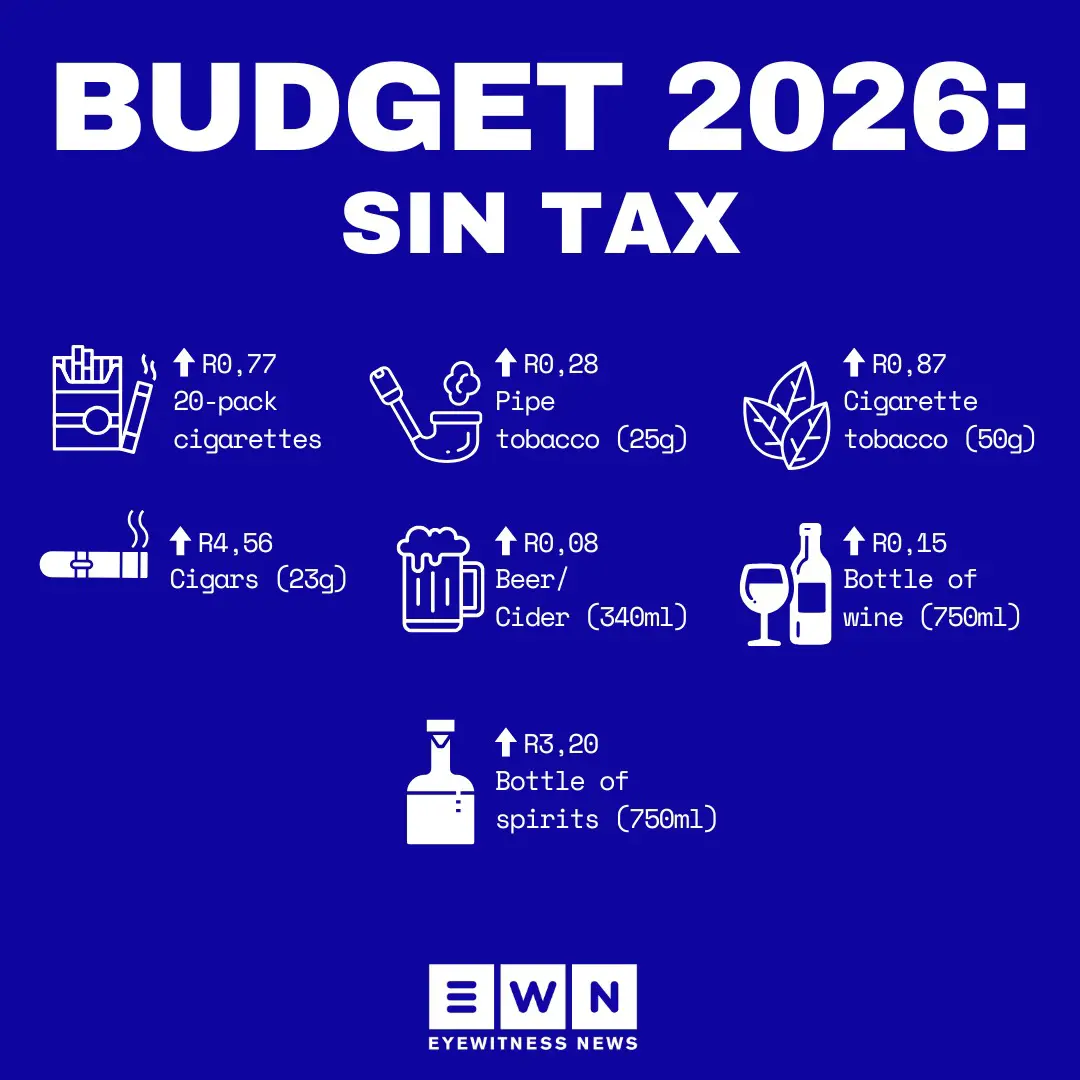
But consumers will have to pay for their sins.
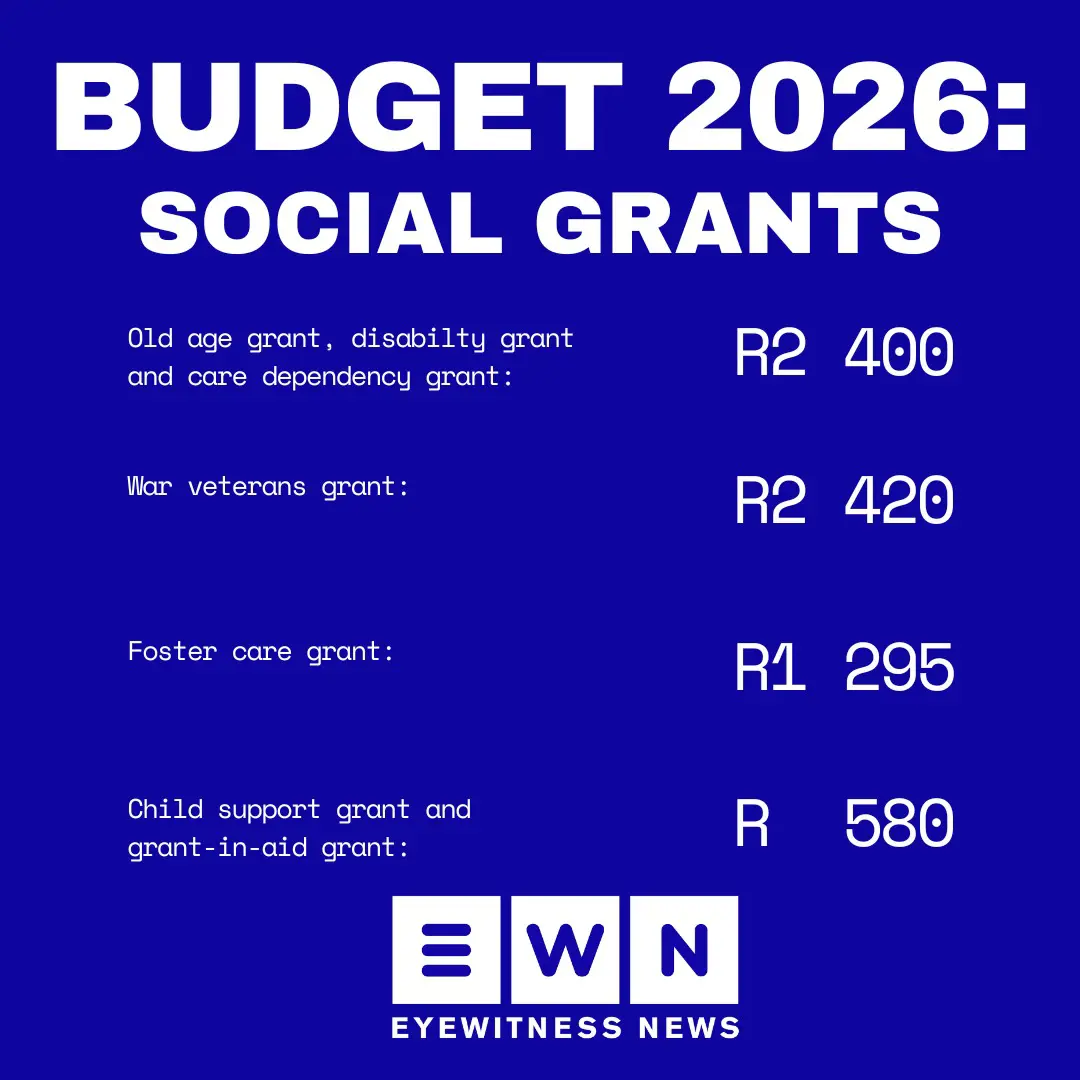
And relief for already overtaxed consumers and pinched households? Some minor grant increases.
In total, the 2026/27 spend will come up to R2.67 trillion.
“This spending includes a proposed R5 billion in the contingency reserve to cater to disasters declared since the MTBPS. Government spending remains highly redistributive. The social wage accounts for more than 60 per cent of non-interest spending over the medium term. Basic education, health and social protection constitute 70.3 per cent of the social wage in 2026/27, providing support to 13.6 million school children, healthcare services to 84 per cent of the population and social grants to 26.5 million beneficiaries.”
In a year of local government elections described as the most competitive in democratic history, it is no surprise that Godongwana has singled out municipalities.
ALSO READ: Godongwana unveils efficiency drive and ghost employee crackdown to curb spending
“A central challenge with municipalities is that they not only differ in capacity, but also in their revenue-raising potential. This demands a more targeted approach to respond to the diverse pressures facing municipalities. The National Treasury is revitalising support for development of long-term financial plans. These plans will improve project identification, sustainably plan cash flows and inform financial decisions. This will negate the challenge of unfunded mandates and limited capacity to maintain infrastructure and sustain services,” he said.
With that, also comes a warning for Joburg to shape up or face national government intervention for a city that’s at the centre of driving the country’s economy.
Godongwana’s speech has been widely welcomed, getting a nod from some political parties and the business sector.
The market also responded well to the better fiscal picture and renewed commitments, with the rand strengthening to R15,89 against the dollar (at 16:28).
The JSE All Share Index also gained 1.53% to sit at 127,073 points.
Get the whole picture 💡
Take a look at the topic timeline for all related articles.
Trending News
- 18 hours ago
Health Minister visits Mankweng hospital following death of one of conjoined twins
- 19 hours ago
Transport MEC says human error to blame for three major Easter crashes in Limpopo
- Yesterday
One of conjoined twins separated in historic surgery in Limpopo passes away
- Yesterday
Head-on collision involving two vehicles on R37 in Ga-Chuene
- 03/04, 08:10
SIU probes R14m in COVID-19 tender fraud as asset recovery intensifies
- 03/04, 07:30
TRC recusal challenge: Zuma condemns leaked letter over Concourt move
- 03/04, 07:15
Cost of Living report shows households in SA are buckling under pressure
- 03/04, 06:30
Cabinet slams so-called coronation of Nigerian 'King'
- 02/04, 15:00
Search and seizure warrant executed at home of Sergeant Fannie Nkosi
- 02/04, 14:30
Zuma approaches Constitutional Court in urgent bid to remove Justice Khampepe
- 02/04, 12:15
Dr Ngobani Makhubu appointed new SARS Commissioner
- 02/04, 12:00
Minister Ntshavheni blames panic buying for dry pumps, rules out war impact